Engineering Innovation Challenge
The Engineering Innovation Challenge (EIC) 2026 at SUTD asked teams to build a working prototype, write a report, and produce a two-minute video. Our team, U-43, built the second generation of Project Gaitway, a lightweight and modular rehabilitation exoskeleton that combines robotic hip assistance, distributed wearable sensing, a live clinician dashboard, and Galvanic Vestibular Stimulation (GVS) for balance support. The team reached the final round (Phase C).
I worked on Gaitway with teammate Joseph Leong Zhen Zhe. My focus was the sensing and computation side of the system.
- Sensing and computation subsystem
- IMU integration and motion tracking
- ESP32 firmware and electronics
- Motor and actuation integration, including ODrive and Hall sensor calibration
- Prototype testing and debugging
Stroke survivors often live with impaired gait, poor balance, and a higher risk of falls. Robotic rehabilitation helps, but most exoskeletons are bulky, expensive, and confined to clinics. Consultations with clinicians at Tan Tock Seng Hospital showed that long-term rehabilitation is also limited by cost, caregiver dependence, and inconsistent access to therapy.
Three microcontroller nodes share the work. IMUs on the waist and thighs feed a waist hub that estimates gait phase, cadence, walking symmetry, and trunk orientation. The hub sends those metrics to the dashboard and to an output node, which drives the motor through an ODrive controller and generates the control signal for the GVS current driver. The contralateral thigh node links to the hub wirelessly over ESP-NOW.
- IMUs: BNO085 sensors on the waist and thighs
- Motion processing: sensor fusion on the ESP32 waist hub
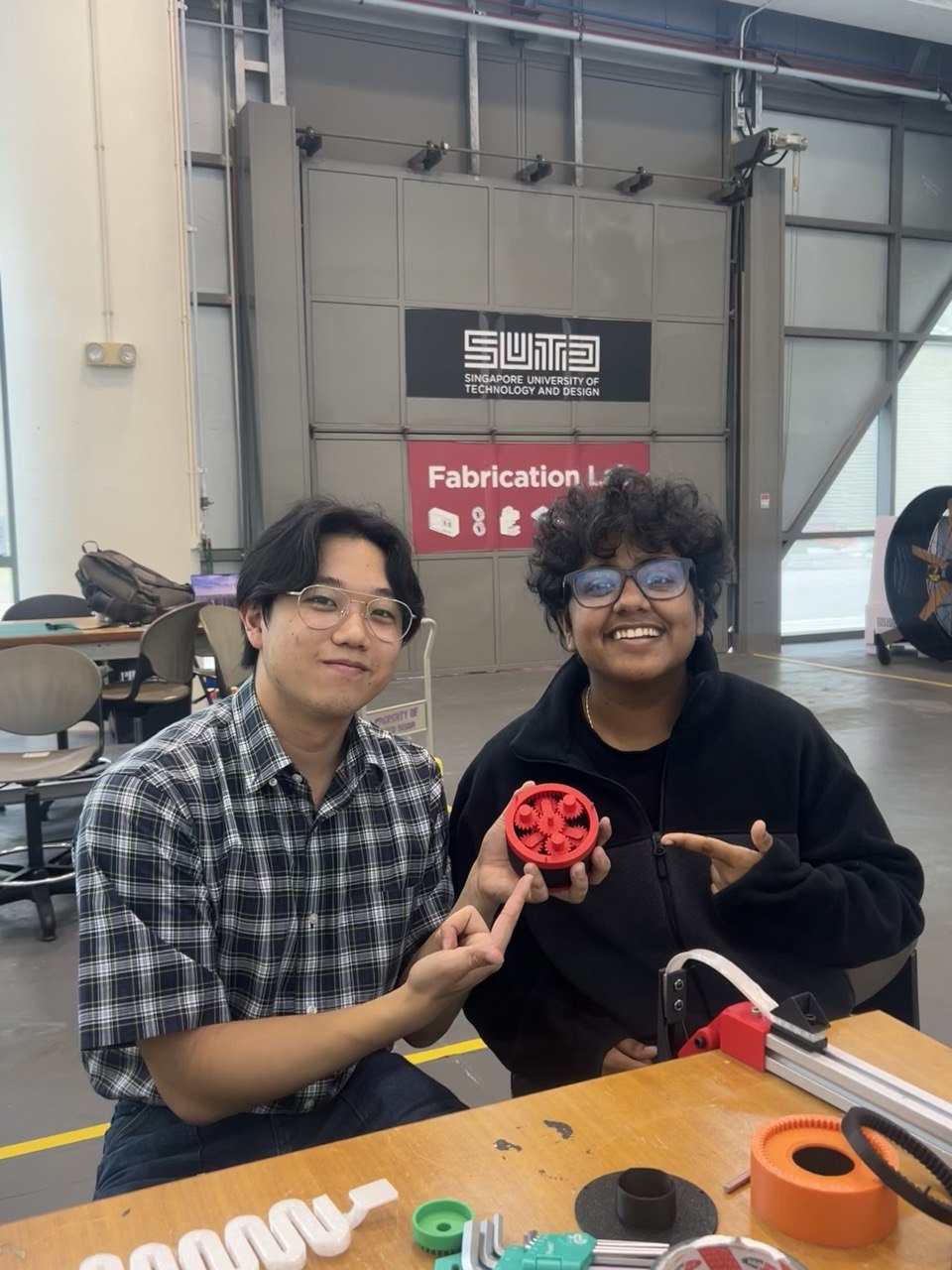
- Actuation: CubeMars BLDC servo through a custom two-stage planetary gearbox
- Balance support: GVS current driver with a fail-safe zero-current startup
- Monitoring: live dashboard showing gait metrics and system status
- Compared capstan, cycloidal, and planetary transmissions on weight, complexity, and back-drivability
- Redesigned the actuator from a stepper and capstan drive to a BLDC servo with a planetary gearbox
- Prototyped in PLA, then moved to carbon fibre reinforced PPA for the final structure
- Built and debugged the distributed sensing, motor control, and GVS electronics
- Tested with participants, first unpowered for comfort and back-drivability, then powered with handrail support
- ESP32 and XIAO ESP32-C3 microcontrollers, embedded C/C++
- BNO085 IMUs with sensor fusion for gait phase, cadence, symmetry, and trunk lean
- UART and ESP-NOW communication between nodes
- ODrive S1 with a CubeMars RI80 BLDC servo, 13.5:1 two-stage planetary reduction
- Parametric CAD with 3D-printed structural parts
- Actuator: stepper motor to CubeMars RI80 BLDC servo
- Transmission: capstan (about 650 g) to a two-stage planetary gearbox (about 275 g)
- Sensing: basic IMUs to a distributed IMU network
- Telemetry: none to a live dashboard
- GVS: initial prototype to an integrated controller
- Reached the final round (Phase C) of EIC 2026
- Built the prototype with around S$700 in funding
- Passive back-drivability and powered hip assistance demonstrated
- IMU sensing and wireless communication were reliable and stable in testing
- GVS hardware bench validated. No stimulation was applied to human participants, for safety
- Next steps: clinical validation of GVS, bilateral actuation, and adaptive machine learning to personalise assistance
- Team U-43 is featured on page 35 of the official EIC 2026 booklet